publications
publications by categories in reversed chronological order. generated by jekyll-scholar.
2026
- DSLeveraging Spatial Transcriptomic Through a Heterogeneous Graph-Based Method for Spot-Level Cancer Tissue ClassificationVeronica Buttaro, Antonio Pellicani, Annalisa Occhipinti, Claudio Angione, Michelangelo Ceci, and Gianvito PioIn Discovery Science, 2026
Spatial transcriptomics measures gene expression while preserving the spatial organization of transcripts within tissue sections. Combined with complementary modalities such as histological images, these data enable a comprehensive characterization of tissue architecture and disease-associated patterns. Machine learning approaches, particularly deep learning and graph-based models, have proven effective in extracting meaningful representations from these heterogeneous data. However, many existing methods analyze tissue sections independently, mostly relying on the assumption that spatially adjacent spots are functionally similar, which often fails in cancer tissues where sharp tumor-stroma boundaries exist. Moreover, most existing approaches consider each patient separately, limiting generalization across individuals. In this paper, we introduce HG-SC, a graph-based method for spot-level classification that integrates three complementary modalities: gene expression values, tissue morphology from paired hematoxylin and eosin images, and the spatial coordinates of each spot within the tissue. Unlike existing methods, HG-SC constructs a unified graph across different patients and tissue sections, enabling the model to capture shared biological patterns within a patient tissue, taking into account patient-specific variations. We evaluate HG-SC on a colorectal cancer dataset gathered from the HEST-1K repository using a tumor-versus-stroma classification task under a leave-one-patient-out cross-validation setting. Our results show that HG-SC consistently outperforms existing multi-modal and unimodal approaches, also due to its ability to capture pathological patterns across patients.
- A novel graph-based patient embedding method for the diagnosis of Alzheimer’s disease from microRNA expression dataVeronica Buttaro, Antonio Pellicani, Gianvito Pio, Domenica D’Elia, Cristina Pizzulli, and Michelangelo CeciData Mining and Knowledge Discovery, 2026
As key players of gene expression regulation, microRNAs (miRNAs) are involved in the onset and progression of many diseases. Because of their presence in organic fluid, such as blood or urine, they are optimal candidates as disease biomarkers that can be easily detected in liquid biopsy, which is less invasive and expensive than traditional techniques. In this paper, we propose a novel patient embedding method, called GraphiRNA, to support the diagnosis of Alzheimer’s disease from miRNA expression values. GraphiRNA is capable of capturing information about the relationships among miRNAs, estimated through the correlation of their expression values over a set of patients, and also integrate the information about their RNA sequences. Notably, GraphiRNA is able to properly model negative correlations by introducing synthetic nodes into the network, to avoid discarding the sign of correlations (and the associated information), as done by existing approaches. Our experimental evaluation, performed on real data from three studies on Alzheimer’s disease, showed superior classification performances of GraphiRNA, especially in patients affected by Mild Cognitive Impairment (MCI), which outlines the potential of GraphiRNA of being adopted as a diagnostic tool for the early intervention. Finally, our ablation study on the approach adopted to handle negative correlations showed an improvement reaching 30.9% in terms of F1-score over an approach that discards the sign of correlations, confirming our initial intuition about the importance of properly considering such information.
- Dynamic instance weighting for online learning in multi-cryptocurrency price and trend forecastingAntonio Pellicani, Gianvito Pio, Sašo Džeroski, and Michelangelo CeciData Mining and Knowledge Discovery, 2026
The cryptocurrency market represents a significant innovation in the financial ecosystem, built upon cryptographic principles to ensure secure and transparent transactions. Cryptocurrencies experienced a global adoption, driven by their decentralized nature that enables borderless transactions without third-party intermediaries. The price of cryptocurrencies is characterized by a significant volatility, that introduces both opportunities and challenges. In this context, the development of accurate methods for the forecasting of price variation, able to work in real-time on data streams, has become vital for various stakeholders. In this paper, we propose a novel approach, called LEMON, for the online prediction of the price variation of cryptocurrencies, that leverages possible temporal correlations among them. Our approach stems from the empirical evidence that cryptocurrencies tend to form groups characterized by similar trends, a behavior often attributed to shared market dynamics and common external factors. Through the analysis of temporal correlations, LEMON dynamically identifies these groups, that are then exploited to learn multiple multi-target tree-based models, specifically designed for processing continuous data streams. LEMON also introduces a novel adaptive non-parametric weighting scheme, that automatically adjusts the importance of each instance based on the observed data distribution in real-time, improving the forecasting of the price variation. Our experiments, performed on 16 datasets related to 16 cryptocurrencies, demonstrate that LEMON outperforms state-of-the-art approaches in two distinct prediction tasks: forecasting the closing price variation (regression) and predicting the market trend direction (classification), making it an effective tool to support stakeholders requiring accurate real-time predictions.
- Leveraging textual content, citational aspects and dissenting opinions through a multi-view contrastive learning methodology for legal precedent analysisGraziella De Martino, Piero Marra, Annunziata D’Aversa, Lorenzo Pulito, Antonio Pellicani, Gianvito Pio, and 1 more authorComputer Law & Security Review, 2026
Artificial Intelligence is transforming the digital justice field by introducing technologies to automate document review, predict case outcomes, and perform legal research tasks. While offering significant benefits, these systems appear to prioritize decision-making patterns that are simply repeated over time, thus neglecting the importance of a dynamic evolution and potentially leading to the risk of stagnation of case law. To mitigate this risk, this paper proposes ContraLEX, a methodology based on a multi-view contrastive learning framework to compare legal judgments, considering those from the European Court of Human Rights as an emblematic case study. Methodologically, our goal is to capture the positive influence on the similarity, provided by both textual content and citations of precedents, and the negative influence of dissenting opinions, by relying on a contrastive learning approach. We argue that our methodology can enhance legal analysis by creating a proper representation of case law to prevent the stagnation of legal precedents and promote their evolution over time. A case study on ECtHR data empirically demonstrated that the proposed pipeline is very promising for properly supporting legal precedent analysis.
- ISMISSimilarity-Guided Forecasting of Multiple Sequences from Mechanical Testing Data of Additively Manufactured ComponentsAntonio Pellicani, Gianvito Pio, Donato Malerba, and Michelangelo CeciIn International Symposium on Methodologies for Intelligent Systems, 2026
Additive manufacturing processes can generate heterogeneous mechanical testing data, which can be precious to characterize and predict material performance. In this work, we propose a similarity-guided forecasting method to analyze multivariate time series acquired during mechanical testing of additively manufactured components. The proposed method first clusters test trajectories via Dynamic Time Warping similarity measure, computed on force response signals, then trains cluster-specific LSTM-based models for multi-step multivariate forecasting. We evaluate the proposed approach on a public dataset comprising bending and compression tests, systematically analyzing the effect of different DTW windowing strategies and of the number of clusters. The obtained results show that computing DTW similarity on the entire time series, combined with a relatively small number of clusters, yields the best forecasting performance, with substantial improvements over a baseline model trained on full unclustered data.


2025
- NFMCP@ECML PKDDConversational Knowledge Extraction from Technical Manuals: An LLM-Based Framework with Ontological GuidanceCeleste Sguera, Antonio Pellicani, Giuseppe Modugno, Angelo Giannoccaro, and Michelangelo CeciIn Joint European Conference on Machine Learning and Knowledge Discovery in Databases, 2025
The effective extraction and structuring of knowledge from technical documentation remains a significant challenge in both educational and industrial contexts. Traditional information extraction approaches show limitations in capturing complex relationships and domain-specific terminology present in procedural manuals. This paper presents a novel intelligent framework that combines Large Language Models with ontological guidance for automatic extraction of entities and semantic relationships from educational manuals. The system integrates preprocessing and indexing of manuals, knowledge extraction based on Retrieval-Augmented Generation with ontological constraints, and conversational interaction for real-time procedural guidance. Evaluation across ten diverse scientific manuals demonstrated strong performance in tasklist extraction, question-answering, and action validation tasks.
- IMMENSE: Inductive Multi-perspective User Classification in Social NetworksFrancesco Benedetti, Antonio Pellicani, Gianvito Pio, and Michelangelo CeciOnline Social Networks and Media, 2025
Online social networks increasingly expose people to users who propagate discriminatory, hateful, and violent content. Young users, in particular, are vulnerable to exposure to such content, which can have harmful psychological and social repercussions. Given the massive scale of today’s social networks, in terms of both published content and number of users, there is an urgent need for effective systems to aid Law Enforcement Agencies (LEAs) in identifying and addressing users that disseminate malicious content. In this work we introduce IMMENSE, a machine learning-based method for detecting malicious social network users. Our approach adopts a hybrid classification strategy that integrates three perspectives: the semantics of the users’ published content, their social relationships and their spatial information. Such contextual perspectives potentially enhance classification performance beyond text-only analysis. Importantly, IMMENSE employs an inductive learning approach, enabling it to classify previously unseen users or entire new networks without the need for costly and time-consuming model retraining procedures. Experiments carried out on a real-world Twitter/X dataset showed the superiority of IMMENSE against five state of the art competitors, confirming the benefits of its hybrid approach for effective deployment in social network monitoring systems.
- Positional trace encoding for next activity prediction in event logsAntonio Pellicani, and Michelangelo CeciKnowledge-Based Systems, 2025
The analysis of log data, generated by running processes in many application domains, enables organizations to identify opportunities for operational improvements. For instance, in healthcare, analyzing patient treatment logs can optimize care pathways; in manufacturing, production line logs can reveal bottlenecks; and in customer service, ticket resolution logs can streamline response protocols. One key analytical task is predicting the next activity in a process, which supports operational decision-making through better resource allocation and proactive response to customer needs. In this paper, we solve the next activity prediction task by exploiting a novel positional encoding approach that is based on sliding windows. This approach allows us to consider both a way to adapt to changes in the data distribution, and exploit positional information of the activities in the traces. The method proposed in this paper, called OREO, takes into account these aspects through a positional encoding tightly coupled with specific types of deep neural network architectures. The results on eight real-world process logs show the superiority of the models exploiting OREO encoding over state-of-the-art approaches, confirming our initial intuition of benefits gained by combining a time-window based model with positional information.
- CARROT: Simultaneous prediction of anomalies from groups of correlated cryptocurrency trendsAntonio Pellicani, Gianvito Pio, and Michelangelo CeciExpert Systems with Applications, 2025
Cryptocurrencies are virtual currencies that exploit cryptography to perform secure financial transactions. They gained widespread popularity in recent years due to their decentralized nature, (pseudo-)anonymity, and ability to facilitate cross-border transactions without the need for intermediaries. However, their price on the market exhibits a huge volatility, that makes them prone to market anomalies. Therefore, predicting anomalies in cryptocurrency time series can be considered an important task for financial institutions, traders, and investors, to maximize their profit or minimize losses. In this paper, we propose a novel approach for predicting anomalies in cryptocurrency time series by exploiting temporal correlations among different cryptocurrencies. Our approach, called CARROT, is based on the idea that groups of cryptocurrencies exhibit similar trends, possibly due to common influencing factors. CARROT analyzes the temporal correlation between different cryptocurrencies, and identifies clusters showing similar patterns that can be useful for gaining insights into future anomalies. Subsequently, CARROT exploits multiple (i.e., one for each cluster) multi-target LSTM models to predict anomalies. Our experiments, performed on a dataset of 17 cryptocurrencies, proved that CARROT outperforms single-target LSTM models of up to 20%, as well as other approaches based on neural networks, i.e., MLP and CNN, in terms of macro F1-score. Therefore, the proposed approach can be considered as a promising tool for predicting anomalies in cryptocurrency time series data and can potentially be used to improve risk management and trading strategies in the cryptocurrency market.
- ICHMSRobust Human Activity Prediction Through Multi-View Sensor Data IntegrationNiccolò Petti, Antonio Pellicani, Fabio Frustaci, Francesco Porreca, and Gianvito PioIn 2025 IEEE 5th International Conference on Human-Machine Systems (ICHMS), 2025
Human Activity Prediction (HAP) systems play a crucial role in assisting caregivers by enabling timely assistance and preventive interventions for the elderly. In this work, we present a multi-view approach to HAP that leverages data from multiple sensor sources to enhance system robustness against noise and missing sensor data. We evaluate our approach for data integration using Random Forests and LSTM models on two real-world datasets, demonstrating that integrating heterogeneous sensor streams allows the system to exploit their complementary nature. Our experimental results show that the multi-view approach significantly improves prediction accuracy, with LSTM networks benefiting more substantially from multiple views compared to Random Forest models. We also investigate the impact of missing sensor data, a common challenge in real-world deployments, and demonstrate that Random Forest models exhibit greater resilience to sensor failures. Additionally, we address the challenge of class imbalance through SMOTE, which proves to be particularly effective for LSTM models. This work provides empirical evidence for the benefits of multi-view learning in HAP systems, particularly in environments where sensor reliability cannot be guaranteed.
- ICHMSStreamlining Serial Communication Protocol Development on SoC Platforms for Code ReusabilityFrancesco Porreca, Raffaele Gravina, Antonio Pellicani, Niccolò Petti, and Fabio FrustaciIn 2025 IEEE 5th International Conference on Human-Machine Systems (ICHMS), 2025
In IoT and wearable systems based on System on Chip (SoC), wired communication with off-chip devices is an essential part of the design. Developing this communication interface is not trivial and often application-dependent, which limits the re-usability of the code. This paper presents an effective method to simplify the development of communication interfaces and reduce their dependency on specific applications by providing useful design guidelines. In particular, our study targets complex computing platform such as heterogeneous SoCs, which integrate a general purpose processor and a Field Programmable Gate Array (FPGA) based programmable logic where hardware accelerators can be implemented. As a result of this work, we have developed a software library that can be reused for all devices utilizing i2c serial communication.
- ITADATAA Secure AI-enabled Platform to Support the Automated Alzheimer’s Disease DiagnosisClaudio A Ardagna, Veronica Buttaro, Michelangelo Ceci, Marco Luzzara, Antonio Pellicani, Gianvito Pio, and 1 more authorIn Proceedings of the 4th Italian Conference on Big Data and Data Science (ITADATA), 2025
This paper presents the BA-PHERD platform, a secure AI-enabled platform for automated Alzheimer’s disease diagnosis using microRNA expression data. The BA-PHERD platform employs a cloud-edge architecture with secure data ingestion, governance-compliant storage, and role-based access control to ensure privacy protection. From a machine learning viewpoint, the platform also introduces a novel patient embedding method that captures regulatory relationships between miRNAs through a correlation network, integrating expression patterns with RNABERT sequence features and miRNA expression values. Unlike traditional approaches treating miRNAs independently, our method constructs a correlation network and applies a GraphSAGE-based approach to generate comprehensive patient representations. Experimental validation on a dataset comprising 1,256 subjects (300 controls, 115 MCI, and 841 AD patients) demonstrates significant improvements, achieving F1-score of 0.66 and an accuracy value of 0.76, over competitor methods.
- SEBDIntegrating Semantic, Social, and Spatial Dimensions for Inductive Malicious User Detection in Social NetworksFrancesco Benedetti, Antonio Pellicani, Gianvito Pio, and Michelangelo CeciIn Proceedings of the 33rd Symposium of Advanced Database Systems (SEBD), 2025
Social networks have become central platforms for shaping public discourse, influencing opinions, and facilitating communication. However, these platforms also increasingly serve as breeding grounds for radicalization and the dissemination of hateful or criminal ideologies. With the exponential growth of users and content on social networks, an effective monitoring and detection of harmful actors have become critical for both societal wellbeing and security. In this discussion paper, we introduce IMMENSE, a novel machine learning-based system for detecting malicious social media accounts. Our framework leverages a multi-perspective approach that integrates three complementary dimensions to classify users: the semantics of the content they generate, the topology of their social relationship network, and the spatial information derived from their geographical position. The key innovation of our system lies in its inductive architecture, which enables generalization to previously unseen users or entirely new networks without requiring retraining, thus achieving significant advancement in both efficiency and practical applicability. We validate IMMENSE against a state-of-the-art transductive system using two diverse datasets extracted from the X social network, demonstrating competitive performance despite the inherent additional challenges introduced by the inductive setting.


2024
- ISMISExploiting microRNA Expression Data for the Diagnosis of Disease Conditions and the Discovery of Novel BiomarkersDaniele Rosa, Antonio Pellicani, Gianvito Pio, Domenica D’Elia, and Michelangelo CeciIn International Symposium on Methodologies for Intelligent Systems, 2024
MicroRNAs (miRNAs) play key roles in diseases and their detection in circulating biofluids makes them optimal candidate as disease biomarkers for improved diagnosis, prognosis, and therapy. Therefore, a thorough understanding of miRNAs in diseases is crucial for realizing their clinical potential.
- ITADATAMulti-view Learning for the Identification of Risky Users in Dynamic Social NetworksFrancesco Benedetti, Antonio Pellicani, Gianvito Pio, and Michelangelo CeciIn Proceedings of the 3rd Italian Conference on Big Data and Data Science (ITADATA), 2024
Technological progress in the last few decades has granted an increasing number of people access to social media platforms such as Facebook, X (formerly Twitter), and Instagram. Consequently, the potential risks associated with these services have also risen due to users exploiting these services for malicious purposes. The platforms have tools capable of detecting and blocking dangerous users, but they primarily focus on the content posted by users and usually overlook additional factors, such as the relationships among users. Another key aspect to consider is that users’ beliefs and interests evolve over time. Therefore, a user who can be considered safe at one moment might later become malicious, and vice versa. This work describes a novel approach to node classification in temporal graphs, aimed at classifying users in social networks. The method was evaluated on a real-world scenario and was compared to a state-of-the-art system that treats the network as a static entity. Experiments showed that taking into account the temporal evolution of the network, in terms of node features and connections, is beneficial.
2023
- Huri: Hybrid user risk identification in social networksRoberto Corizzo, Gianvito Pio, Emanuele Pio Barracchia, Antonio Pellicani, Nathalie Japkowicz, and Michelangelo CeciWorld Wide Web, 2023
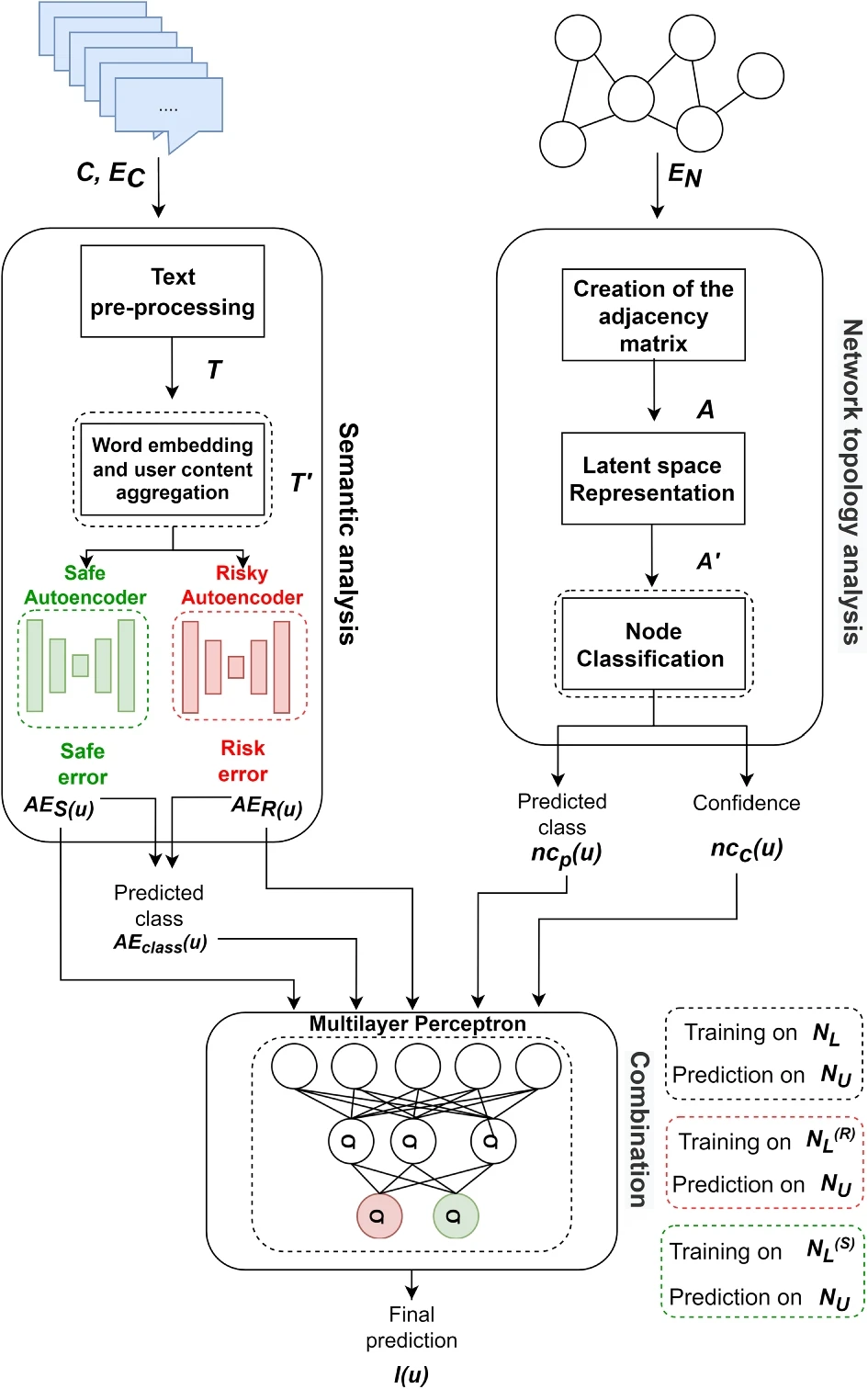
The massive adoption of social networks increased the need to analyze users’ data and interactions to detect and block the spread of propaganda and harassment behaviors, as well as to prevent actions influencing people towards illegal or immoral activities. In this paper, we propose HURI, a method for social network analysis that accurately classifies users as safe or risky, according to their behavior in the social network. Specifically, the proposed hybrid approach leverages both the topology of the network of interactions and the semantics of the content shared by users, leading to an accurate classification also in the presence of noisy data, such as users who may appear to be risky due to the topic of their posts, but are actually safe according to their relationships. The strength of the proposed approach relies on the full and simultaneous exploitation of both aspects, giving each of them equal consideration during the combination phase. This characteristic makes HURI different from other approaches that fully consider only a single aspect and graft partial or superficial elements of the other into the first. The achieved performance in the analysis of a real-world Twitter dataset shows that the proposed method offers competitive performance with respect to eight state-of-the-art approaches.
- SAIRUS: Spatially-aware identification of risky users in social networksAntonio Pellicani, Gianvito Pio, Domenico Redavid, and Michelangelo CeciInformation Fusion, 2023
The massive spread of social networks provided a plethora of new possibilities to communicate and interact worldwide. On the other hand, they introduced some negative phenomena related to social media addictions, as well as additional tools for cyberbullying and cyberterrorism activities. Therefore, monitoring operations on the posted contents and on the users behavior has become essential to guarantee a safe and correct use of the network. This task is even more challenging in presence of borderline users, namely users who appear risky according to their posts, but not according to other perspectives. In this context, this paper contributes towards an automated identification of risky users in social networks. Specifically, we propose a novel system, called SAIRUS, that solves node classification tasks in social networks by exploiting and combining the information conveyed by three different perspectives: the semantics of the textual content generated by users, the network of user relationships, and the users’ spatial closeness, derived from the geo-tagging data associated with the posted contents. Contrary to existing approaches that typically inject features built from one perspective into the other, we learn three separate models that exploit the peculiarity of each kind of data, and then learn a model to fuse their contribution using a stacked generalization approach. Our extensive experimental evaluation, performed on two variants of a real-world Twitter dataset, revealed the superiority of the proposed method, in comparison with 15 competitors based on one of the considered perspectives alone, or on a combination thereof. Such a superiority is also clear when specifically focusing on borderline users, confirming the applicability of SAIRUS in real-world social networks, which are potentially affected by noisy data.
- NFMCP@ECML PKDDReal-Time Anomaly Prediction from Cryptocurrency Time SeriesAntonio Pellicani, Gianvito Pio, Sašo Džeroski, and Michelangelo CeciIn Joint European Conference on Machine Learning and Knowledge Discovery in Databases, 2023
Cryptocurrencies have gained popularity for their decentralized nature and ability to facilitate secure cross-border transactions, but they are susceptible to market volatility and anomalies. This extended abstract introduces a new real-time anomaly prediction method for cryptocurrency time series, that exploits temporal correlation. The proposed approach analyzes the temporal correlation between similar cryptocurrencies to identify clusters exhibiting similar patterns that may provide insights about future anomalies. Subsequently, an online multi-target LSTM model is adopted to predict upcoming anomaly events. Our preliminary experiments on 17 real-world cryptocurrency demonstrated the potential of the proposed approach for detecting anomalies and improving trading strategies in the cryptocurrency market.
- SEBDA Multi-Perspective Approach for Risky User Identification in Social Networks.Antonio Pellicani, Gianvito Pio, and Michelangelo CeciIn Proceedings of the 31st Symposium of Advanced Database Systems (SEBD), 2023
Social networks have become an integral part of modern communication, allowing people to connect and interact across the globe. However, they also bring along some negative phenomena, such as cyberbullying and social media addiction. As a result, monitoring user behavior and content has become essential to ensure a safe and responsible use of social networks. In this context, we recently proposed a novel system called SAIRUS, that we describe in this discussion paper. SAIRUS adopts three separate models to learn from multiple perspectives of social network data, namely the content posted by users, their relationships and their spatial closeness. We compare the system performance with 13 competitors on two real world datasets, demonstrating its superiority in identifying risky users and its usefulness as a tool for social network analysis.

2020
- NFMCP@ECML PKDDLeveraging multi-target regression for predicting the next parallel activities in event logsMichelangelo Ceci, Angelo Impedovo, and Antonio PellicaniIn Workshops of the European Conference on Machine Learning and Knowledge Discovery in Databases (ECML PKDD 2020): SoGood 2020, PDFL 2020, MLCS 2020, NFMCP 2020, DINA 2020, EDML 2020, XKDD 2020 and INRA 2020, 2020
Next activity prediction is one of the most important problems concerning the operational monitoring of processes, that is, supporting the user in predicting the activity that will be executed as the next step during process execution. However, traditional algorithms do not cope with the presence of parallel activities, thus failing to devise accurate prediction of multiple parallel activities that will be simultaneously executed. Moreover, they often require a trace alignment pre-processing step, which can be infeasible during process executions. In this paper, we propose the ParallAct methodology, in which multi-target regression is used to predict the next parallel activities in event logs without the need of aligning traces during process executions. Experimental results show that the proposed solution achieve more accurate predictions compared to the single-target setting.